Before your parent leaves the hospital, ask for a written medication plan, the warning signs the care team wants you to watch for, follow-up dates, activity or diet instructions, any equipment needed at home, and the phone number to use when a question comes up. Also ask who is responsible for each next step. The goal is to leave knowing what happens tonight, tomorrow morning, and at the first follow-up visit.
Leave with one medication plan you can read at home
Ask for the complete current medication list and compare it with what your parent was taking before the hospital stay. For each medicine, ask what changed, when it should be taken, and whether anything was stopped. If an instruction is unclear, ask the nurse, pharmacist, or other member of the discharge team to explain it in plain language.
Do not rely on memory after a long hospital day. Keep the written list with the discharge papers and make sure the person covering the first evening can find it.
A medication plan is only useful if the next caregiver can follow it.
Ask the care team to name the warning signs
"Call if things get worse" is too vague for 10 p.m. Ask what changes should lead to a routine call, what needs same-day attention, and what the team considers an emergency. Ask which number to use during office hours and which number to use after hours.
The warning signs should come from your parent's clinicians because they depend on why your parent was in the hospital and what treatment they received. Write the instructions down in the same place as the discharge contact numbers.
Specific instructions beat a family guessing game.
Build the first days around named tasks
Before the ride home, picture the first morning. Who is picking up any new prescriptions? Who is making breakfast? Who is checking the discharge papers for the next appointment? Who is staying with your parent if the care team says supervision is needed?
"The question families most often forget is not 'What do we need to do?' but 'Who is responsible for doing each part, and who do we call if it does not go as planned?'" says Dr. Apurv Gupta, VP of Clinical Innovation and Research at HomeTeams. "Discharge instructions only become a care plan when every important task and concern has a clear owner."
That means a discharge checklist works best when it contains actions, not categories. "Transportation" is a heading. "Luis drives Mom to the Tuesday follow-up at 9:30" is a plan. And the second half of Dr. Gupta's question matters just as much: for each task, the family should also know the fallback. If Luis's car won't start, who drives instead? If the pharmacy doesn't have the new prescription, who calls the discharge team?
The first week gets easier when every handoff has a name.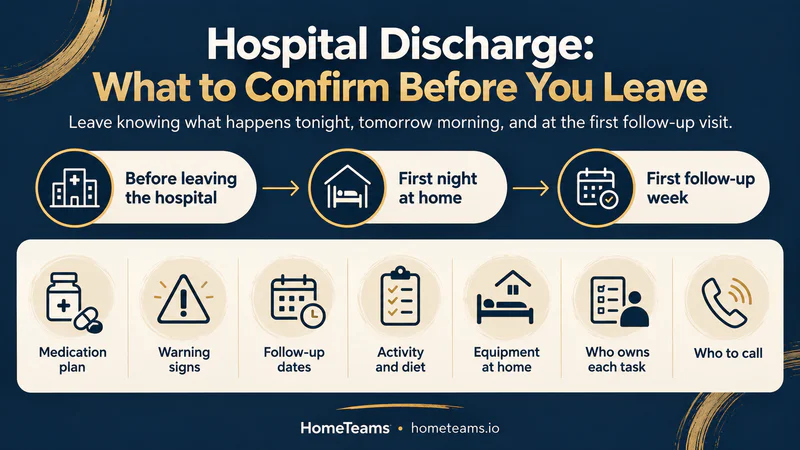
Put follow-up care on the calendar before it disappears into the week
Ask which appointments are already scheduled and which ones the family still needs to make. Confirm the date, location, clinician, and purpose of each visit. If therapy, home health, lab work, or another service is part of the discharge plan, ask when it should start and who will contact whom.
Then arrange the ride. A follow-up appointment is not fully planned if everyone knows the date but nobody knows who is driving.
A calendar entry needs an owner, not just a time.
Prepare the home for the instructions you actually received
Ask whether your parent has any limits on stairs, bathing, lifting, driving, or other daily activities. If the discharge team recommends equipment or a home setup change, find out what is needed before buying or installing anything.
Walk the path from the front door to the bedroom and bathroom. Clear loose clutter. Put frequently used items where your parent can reach them without an unnecessary climb or stretch. If the care team has given special instructions for sleeping, meals, mobility, or wound care, set up the home around those instructions.
Prepare for your parent's plan, not a generic recovery checklist.
Split sibling roles before the car reaches the curb
A hospital discharge can turn one family member into the default coordinator in a few hours. Prevent that by naming the first round of responsibilities before everyone leaves.
One sibling might handle the pharmacy stop. Another can cover the first follow-up ride. A third can call relatives with the update so the person at home is not answering the same question six times. Someone should also own the shared schedule and note changes as they happen.
The family does not need equal jobs; it needs visible jobs.
Choose one way to keep everyone updated
Group texts are useful for quick notes, but important instructions can get buried between reactions and side conversations. Pick one place for the current schedule, assigned tasks, and the latest practical update. If something changes, update that source first.
It works a lot like the whiteboard at a hospital nurses' station, except your family is tracking rides, meals, calls, and follow-up tasks at home. The point is not more messages. The point is one current picture.
More communication is not the same as clearer communication.
Track changes without trying to become the clinician
You can keep a short record of symptoms, questions, medication issues, and changes you notice so you have something concrete to discuss at the next call or visit. Use the discharge team's instructions to decide what should be reported and when.
If your parent seems different from what the team told you to expect, use the contact plan they gave you rather than trying to diagnose the change from an app, a search result, or a family debate.
Good notes help you ask better questions.
Make emotional support ordinary
The hospital bracelet is still on the wrist, the discharge folder is on the counter, and the house is suddenly quiet again. Your parent may want company, familiar food, a favorite chair, or simply fewer questions for an hour. Ask what would make the first evening manageable.
Caregivers need room to speak up too. If one person has handled the hospital, the ride home, and the first night, schedule a handoff instead of waiting for that person to ask for rescue.
Care feels more sustainable when asking for relief is normal.
Keep the handoffs visible
If several people are covering rides, appointments, and follow-up tasks, you can keep assigned actions and team messages together in HomeTeams. Start at hometeams.io.