Dividing care works when each real task has one clear owner. “We all help with appointments” sounds cooperative, but it does not tell you who is calling the clinic Monday, who is driving Tuesday, or who is writing down what changed afterward.
Family caregiving can become overwhelming even when several people genuinely want to help. Appointments, prescription pickups, transportation, paperwork, meals, phone calls, follow-ups, and emotional support can quickly become a second calendar layered on top of everyday life. The problem is often not a lack of willing family members. It is that the work has never been made visible enough for people to take responsibility for it.
When one person becomes the default caregiver, that person can also become the family’s unofficial information center. Everyone asks them when the appointment is, whether the prescription was picked up, what the doctor said, and what still needs to happen. Sharing caregiving responsibilities starts by moving those details out of one person’s head and into a system the whole care team can use.
The goal does not have to be a perfectly equal division of labor. Different family members have different schedules, abilities, and relationships with the person receiving care. The goal is clarity. Everyone should be able to answer two questions: What needs to happen next, and who owns it?
Start with honest communication
Use a regular check-in to look at the next stretch of work. It can be ten minutes on Sunday evening. The point is not a family meeting for its own sake. The point is to put the coming jobs on the table while there is still time to assign them.
Keep the questions concrete. Who can drive Tuesday? Who can call the insurance office before Friday? Who is bringing dinner after the appointment? Who needs to confirm the prescription refill? What is still unclaimed?

Between check-ins, put updates in one shared place so the family does not have to reconstruct the plan from old calls and texts.
This is especially important when several family caregivers are involved. Group texts can be useful for conversation, but important tasks can disappear quickly between photos, reactions, side conversations, and unrelated updates. A shared care coordination system gives those responsibilities somewhere permanent to live.
Good communication ends with a next action someone owns.
Assign roles, not vague intentions
Turn broad responsibilities into small, visible actions. “Manage appointments” is too large. “Confirm Tuesday’s appointment by Monday afternoon” is specific enough for one person to own.
Give each action one owner. Other people can help, but one name should answer the question, “Who is carrying this?” Add a date when timing matters.
If the family also wants to name larger caregiving roles, keep them practical. One person may be the main clinic contact. Another may manage transportation. Another may keep current documents organized. Someone who lives farther away may handle insurance calls, appointment scheduling, research, or regular phone check-ins.
Those roles should clarify handoffs, not create titles for their own sake.
A responsibility becomes shareable when you can point to the exact next move.
When caregiving roles conflict
Suppose Maya agreed to drive Tuesday, but her work schedule changes. The useful conversation is not, “You never help.” It is, “Tuesday’s ride is uncovered now. Who can take it?”
If the same mismatch repeats, change the assignment. A caregiving task that consistently conflicts with someone’s actual schedule should move rather than becoming a weekly argument.
This is one reason flexibility matters in a family caregiving plan. A good plan does not assume that everyone’s availability will stay the same. It gives the family a way to see what changed and redistribute the work before something gets missed.
For bigger decisions, know the difference between a family role and legal authority. The person coordinating rides does not automatically have authority over medical or financial decisions. When authority depends on a document or professional guidance, check that source directly.
Solve the task first. Do not turn every missed handoff into a verdict on the person.
Don’t forget the parts that aren’t hands-on care
Care includes work that is easy to leave unnamed. A standing Sunday call with Dad. Updating the emergency contact sheet. Finding the signed power of attorney. Checking whether the primary caregiver needs someone else to cover Saturday morning. Making a meal. Researching transportation. Calling the pharmacy. Keeping siblings updated.
These tasks can create just as much mental load as hands-on caregiving.
Put them on the same visible plan when they matter. The task may be emotional, administrative, or practical, but it still benefits from an owner and a date.
The invisible work becomes easier to share once it is no longer invisible.
Where Coach can help with family care coordination
Caregiving is not only about completing tasks. Families also have to understand the information behind those tasks.
A new appointment may come with unfamiliar terminology. A provider’s instructions may create several follow-up steps. A document may contain information that one family member understands while everyone else waits for that person to explain it.
That creates another form of caregiver mental load.
Coach in HomeTeams can help families make care information easier to understand and act on. Coach can help explain care-related information in plain language and help identify the next actions that may need attention. Those actions might include calling a provider, preparing questions for an upcoming appointment, picking up a prescription, organizing paperwork, or following up with another member of the care team.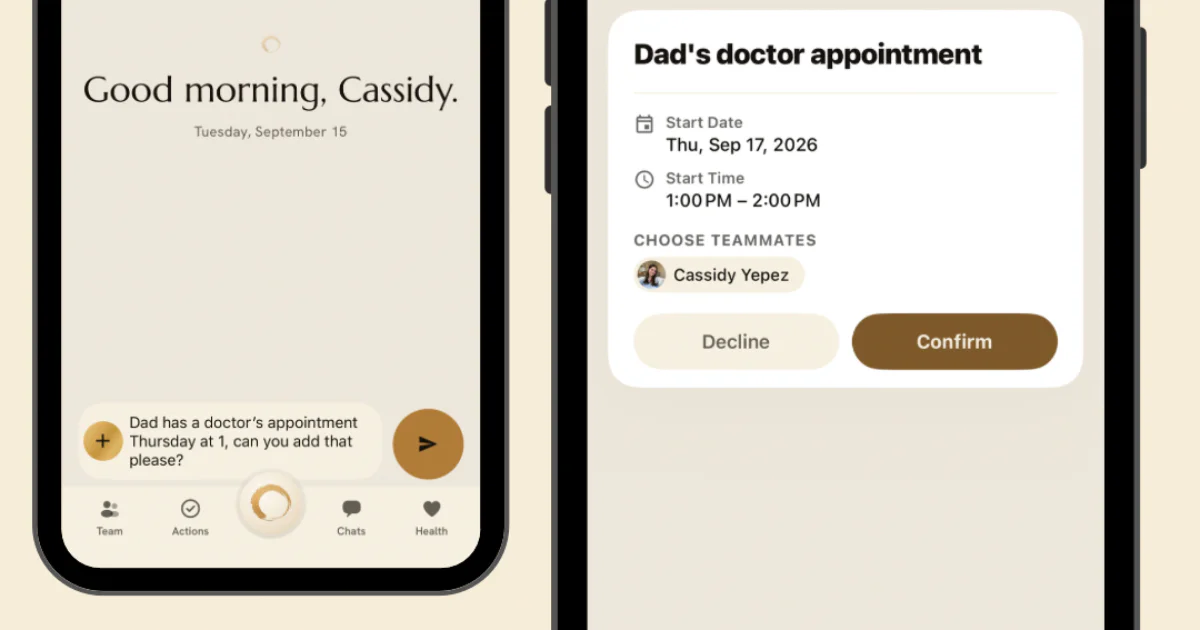
The value is not replacing the clinician, legal decision-maker, or family member responsible for making important decisions. It is helping the team move from information to organization.
Instead of one caregiver receiving information, interpreting it, remembering it, and then repeating it to everyone else, the family has another way to understand what needs attention and translate that understanding into shared next steps.
That distinction matters. Information becomes much more useful when the family can answer, “What do we need to do with this?”
Use one place to hold the handoffs
Family caregiving becomes easier to coordinate when tasks, conversations, and responsibilities are not scattered across several people’s memories.
In HomeTeams, families can create and assign actions, choose who is responsible for each one, add dates when needed, and communicate with individual teammates or groups when a handoff needs discussion. HomeTeams also supports teammate-specific access to notes and documents, helping families keep relevant care information connected to the people who need it.
The result is not necessarily less care. It is clearer care.
Instead of asking one person for every update, family members can see what has been assigned and what still needs attention. Instead of assuming someone else handled a task, there can be a clear owner. And instead of waiting until the primary caregiver feels overwhelmed, families can see the workload and redistribute it earlier.
Sharing caregiving responsibilities is ultimately about building a team around the person you love. That team does not have to contribute in exactly the same way. It simply needs a shared understanding of what needs to happen next.
If your family wants one shared place to organize those handoffs, assign actions, communicate with teammates, and keep care moving forward, start at HomeTeams.io.