Care coordination means putting the medical work and the everyday work in a place where the family can see how they connect. The lab result may belong to the healthcare side, while the ride to Friday's follow-up belongs to daily life, but the same family often has to manage both in the same week.
Why caregiving coordination is genuinely hard
Medical information arrives from different places. One note is in a portal, another is printed after a visit, and a medication list lives in somebody's phone. At the same time, ordinary life keeps moving: work shifts, meals, rides, school pickup, groceries.
Then add several helpers with different schedules. Elena can drive mornings. Marcus can call clinics during lunch. Priya lives farther away but can keep documents organized. Without a shared picture, each person sees only part of the job.
Care gets hard to coordinate when the information and the actions live in separate worlds.
What good coordination actually solves
Start with the handoff between information and action. If Friday's specialist note says a follow-up is needed, somebody should be able to turn that into a visible action with an owner and date.
Keep the supporting information close enough to find. The person making the call may need the visit note, medication list, or insurance card. They should not have to chase another family member just to locate the current copy.
Keep conversation near the work when possible. If the appointment time changes, update the plan and discuss the change where the people handling that appointment will see it.
And when medical wording is hard to understand, use a plain-language explanation as a starting point for better questions, not as a replacement for professional advice.
Coordination is the bridge between "we know this" and "someone is doing the next thing."
Where HomeTeams fits
You can use HomeTeams to create actions for appointments, rides, meals, medications, and errands, then assign who is doing each one. The app also supports one-to-one and group messaging, plus a Resource Library for insurance cards and forms.
Coach can help answer care-related questions and turn guidance into actions. The HomeTeams site also says Coach translates medical language into plain English.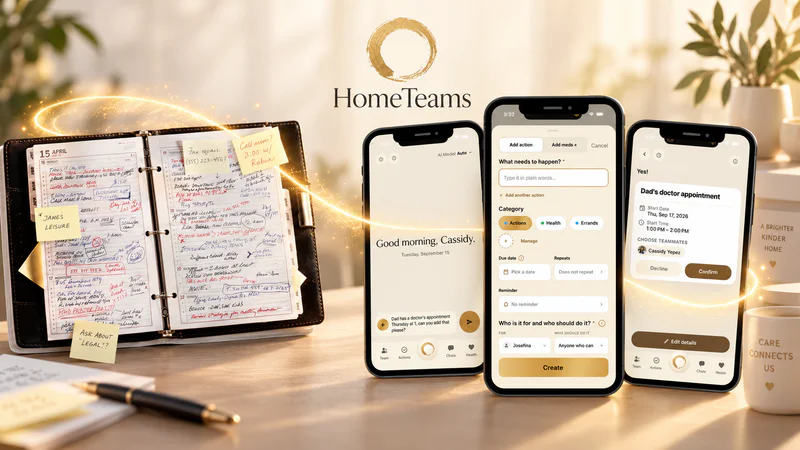
The family remains responsible for deciding what belongs in the plan and who is actually doing it.
What this changes day to day
Suppose a new note arrives after Tuesday's visit. Priya adds the document to the shared record. Marcus reads the plain-language explanation, writes down the question he still has, and calls the clinic. Elena takes the Friday follow-up ride. The action, document, and handoff stay visible to the people who need them.
That is a better test of coordination than whether the family has "everything organized." The useful question is whether the next person can find what they need without starting over.
A shared record earns its place when it makes the next handoff easier.
Do not move every piece of family information at once. Pick the area causing the most repeated searching. Maybe it is appointments. Maybe it is medication lists. Maybe it is the stack of visit notes nobody can find when the clinic calls.
Put that one category in a shared place and practice using it. Then add the next category only when the first one has become the family's normal source.
Start Small
Starting small also makes it easier for everyone to build the habit of checking the same place before sending another text or making another phone call. If the family is constantly asking, “What time is the appointment?” begin with the calendar. If the biggest frustration is not knowing which medication list is current, start there instead. The best first step is the one that removes a repeated source of confusion.
It can also help to choose one person to set up the first category, then make sure everyone knows how to find and update it. That does not mean that person becomes responsible for everything. Their job is simply to help the family establish the shared system.
As the process becomes familiar, add another layer. Appointments might be followed by medication information, then important documents, then recurring caregiving tasks. Over time, the family creates a more complete picture without making the transition feel overwhelming.
The goal is not to build a perfect system overnight. It is to create a reliable place the family actually uses. A simple shared system that everyone checks is more useful than a complicated one that only one person understands.
If your family wants one place for the plan, actions, messages, and health resources, start at hometeams.io.