Why the SNL sketch everyone sent to their family group chat is funny, painful, and completely fixable.
If you haven't seen it yet, someone in your family probably texted it to you this week. Or you texted it to them. Maybe with no caption at all, because the sketch said everything you've been trying to say for years.
On November 15, Saturday Night Live aired a fake commercial called "Sister." John Mulaney plays a smooth pitchman selling the ultimate elder care solution: a live-in, 24/7 caregiver you activate with one text. Two words. "Dad fell."
The product is your sister. She quits her job, breaks her lease, moves across the country, and handles everything. For free. Forever. As the fake doctor in the ad puts it, once your text arrives, you're done for life. See you at the funeral.
We laughed. Then a lot of us went quiet. Because for millions of families, Sister isn't a joke. Sister is the plan.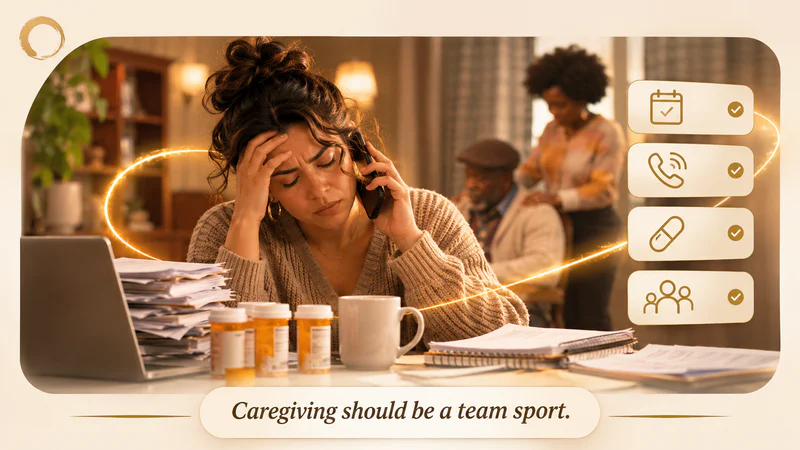
What the sketch got exactly right
Comedy works when it's true, and "Sister" is painfully true in three ways.
It starts small, then it's everything
Nobody signs up to be the family caregiver. It begins with a grocery run, a ride to an appointment, a quick call to the pharmacy. Then a fall. Then a new diagnosis. Experts call this "caregiver creep," and it's how one person ends up holding it all without anyone ever deciding she should.
It usually lands on her
Even in families with plenty of siblings, the bulk of the work tends to fall on a daughter. It's common enough to have a nickname: "the daughter tax." One widely cited study found daughters give more than twice as many hours of care to aging parents as sons do. The sketch's writer, Streeter Seidell, dedicated it to his own sister, Heidi. Which tells you everything.
"Speak to human. Speak to human."
The line that got the biggest groan of recognition was Sister on speakerphone, stuck in an automated phone tree. Doctors, insurance, pharmacy, repeat. That's the invisible part of caregiving. Not just the love and the lifting, but the hold music, the forms, the passwords, the twelve tabs open at midnight trying to figure out which medication changed.
The part that isn't funny
Behind the punchline is a real cost, and it's paid in time, money, and health.
51 million Americans care for a loved one age 50 or older. That's nearly 1 in 5 adults, and 3 in 5 of them are women.
About $120,500 is what an average working caregiver gives up over time in lost wages, retirement savings, and Social Security.
$11,508 a year is the average family caregiver's out-of-pocket spending, almost 60% more than in 2021. For dementia care, it climbs to $15,846.
31% of household income, on average, goes to caregiving expenses.
Nearly 40% of women caregivers say it has hurt their physical health, and 47% say it has worn on their emotional well-being.
Researchers have a name for caregivers in this position: "invisible second patients." They are holding someone else's health together while their own quietly slips.
And many are doing it while raising kids at the same time. The sandwich generation isn't a trend piece. It's a Tuesday.
Why it always falls on one person
It's easy to blame the brother in the sketch. But most families don't land here because people don't care. They land here because there was never a plan, and the person closest to the problem becomes the plan by default.
Dr. Donna Benton, who directs the USC Family Caregiver Support Center, said it well: part of why women feel they have to do it all is that there aren't real outside options. Medicare doesn't cover long-term help with daily things like bathing, dressing, or eating. There's no federal paid family leave. The systems are confusing and short on humans.
So the information lives in one person's head. The appointments live in one person's calendar. The phone calls come to one person's phone. And when everything routes through one person, everyone else can only help if she has the time to tell them how.
That's the real problem the sketch exposes. Not a lack of love. A lack of a team.
The experts quoted after the sketch went viral kept coming back to the same advice: talk before the crisis, divide the work, use a shared calendar, say "we" instead of "you," and ask for help before you're running on empty. All true. The hard part is that most families have no place to actually do any of that.
Every home deserves a team
This is exactly why we built HomeTeams. Not to replace Sister, but to make sure she's never the only one on the field.
Health is a team sport. HomeTeams gives the whole family one place to show up for the person they love, so caregiving stops being one person's secret second job.
One team, one picture
Siblings, spouses, grandkids, neighbors, and care providers can all be on the same team. Everyone sees what's happening, so the person doing the most isn't also stuck being the family's full-time messenger.
Appointments that aren't trapped in one head
Doctor visits and scheduling live where the whole team can see them. The brother three states away can't drive Dad to cardiology, but he can know it's Thursday, call afterward, and take the pharmacy follow-up off his sister's plate.
The Health Vault
Medical records, medications, and history in one secure, HIPAA compliant place. No more digging through a purse full of discharge papers in a waiting room, or being the only person who knows which prescription changed.
Coach AI
A knowledgeable, supportive companion available any hour. Ask what a new diagnosis means, what questions to bring to the next appointment, or how to explain what's going on to the rest of the family. It's AI that makes room for more human connection, not less. (And yes, you get to speak to a human: your own family.)
Care for the caregiver
Coach isn't only for the person receiving care. Caregivers can track their own health too, because the "invisible second patient" deserves to be seen.
Living Legacy
Caregiving is also some of the most meaningful time families get. Living Legacy lets you capture stories, photos, and journal entries along the way, so the memories don't get buried under the logistics.
We aren't selling a product. We're offering peace of mind: the kind that comes from knowing that when the next "Dad fell" text comes, it goes to a team that's ready, not to one person who drops everything.
Before the text comes
Dr. Benton said that if this sketch starts a new national conversation, that alone would be a success. We agree. So let's not just share it. Let's do something with it.
If you're the Sister: you're not being dramatic, and you're not alone. Send this to your family and ask for one specific thing this week.
If you're the one who hasn't been texted yet: don't wait for "Dad fell." Call your sister. Ask what's on her plate. Take something off it.
And if your family is ready to stop running care through one person's phone, build your team on HomeTeams. Because no one should carry it alone.
Sources
Why SNL's "Sister" sketch hit a nerve about the reality of caregiving, Jen Christensen, CNN, November 2026 (caregiving statistics from AARP, the National Alliance for Caregiving, USC, and the University of Toronto)
I'm the "Sister" in the SNL caregiving sketch, TODAY via NBC Los Angeles
The $120,500 cost of being "Sister", Fortune